
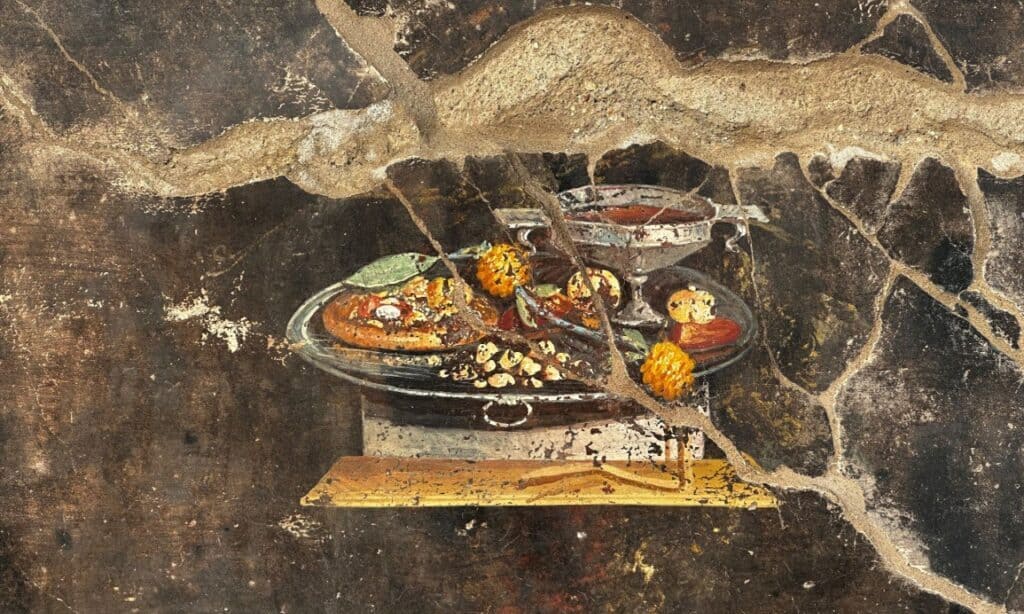
“Pizza” di 2000 anni fa scoperta a Pompei

A 2000-year-old “pizza” discovered in Pompeii

Pompei, l’antica città romana sepolta sotto la lava del Vesuvio, regala sempre nuove sorprese: l’ultima è la scoperta di una pizza in un affresco risalente a circa 2000 anni fa. 

L’affresco è stato ritrovato sul muro di una casa accanto a un antico panificio. Raffigura un prezioso vassoio di argento con sopra un calice di vino, della frutta, e quella che sembra una sorta di pizza tonda.

in realtà, più che una pizza, il disegno ricorda molto una focaccia, condita con frutta e forse spezie.

Un ritrovamento davvero sorprendente, anche se per la vera pizza mancano i due ingredienti fondamentali: la mozzarella e il pomodoro, che arriveranno solo centinaia di anni dopo con la scoperta dell’America.

La notizia ha avuto molta risonanza sia in Italia che all’estero, tanto che a Napoli hanno colto l’occasione per celebrarla: il famoso pizzaiolo napoletano Gino Sorbillo ha provato a ricreare l’antica focaccia, creando la nuova “pizza Pompei”.
Keywords

sepolto/a: buried – 埋葬的

l’ affresco: fresco – 壁画

risalente: dating back – 追溯到 

il panificio: bakery – 面包店

il vassoio: tray – 托盘

una sorta di: a kind of – 一种

la focaccia: focaccia bread – 意式扁饼

tanto che: so much so that – 如此以至于

il pizzaiolo: pizza maker – 披萨师傅

Grammar

Più che… = more than

“più che una pizza, il disegno ricorda molto una focaccia”
(more than a pizza, the drawing closely resembles a focaccia bread)

In this sentence, the expression “più che” is used as a comparative construction meaning “more than” or “rather than.”
It is used to compare two things and emphasize that the resemblance is closer to one thing (focaccia) rather than the other (pizza).
A more familiar and simple way to express the same meaning would be:

– “il disegno ricorda molto una focaccia più che una pizza”

In the article, the usual word order is reversed compared to the normal structure, in order to create a stronger emphasis on the word “pizza”.
Both word orders are grammatically correct and convey the same meaning, hence the choice to reverse the word order is just a stylistic variation.

Let’s see some more exmaples:

  • Più che una casa, quella struttura sembra una villa. (More than a house, that structure resembles a villa.)
  • Più che un amico, lui è come un fratello. (More than a friend, he is like a brother.)
  • Più che un semplice libro, questo è un capolavoro. (More than a simple book, this is a masterpiece.)
  • Più che una città, Roma è un museo a cielo aperto. (More than a city, Rome is an open-air museum.)
  • Più che un problema, questa situazione è una sfida. (More than a problem, this situation is a challenge.)
  • Più che un insegnante, lei è un mentore per me. (More than a teacher, she is a mentor to me.)

Translation

Pompeii, the ancient Roman city buried under the lava of Mount Vesuvius, always reveals new surprises. The latest discovery is a pizza depicted in a fresco dating back approximately 2,000 years.

The fresco was found on the wall of a house next to an ancient bakery. It portrays a precious silver tray with a wine goblet, fruits, and what appears to be a round pizza-like dish.

In reality, more than a pizza, the drawing closely resembles a focaccia bread, topped with fruits and possibly spices.

It is a truly remarkable find, although the true pizza lacks two essential ingredients: mozzarella and tomato, which would only be introduced centuries later with the discovery of the Americas.

The news has gained significant attention both in Italy and abroad. In Naples, they took the opportunity to celebrate it: the famous Neapolitan pizza maker, Gino Sorbillo, attempted to recreate the ancient focaccia, giving birth to the new “Pizza Pompei.”
