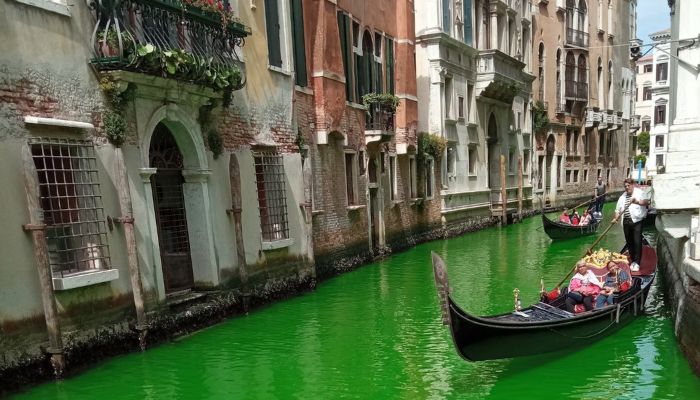
Venezia diventa verde!

Venice turns green!

Nella mattinata di domenica alcuni canali di Venezia si sono colorati di verde fluo.

Le foto sono immediatamente diventate virali su internet, e l’ARPA (agenzia Regionale di Protezione ambientale) ha dichiarato di aver mandato degli esperti per fare degli accertamenti. 

stando ad alcune fonti, questo episodio potrebbe essere legato a una performance dell’artista argentino Nicolas Garcia Uriburu, che durante la Biennale d’arte del 1968 aveva colorato di verde fluo il Canal grande, con lo scopo di sensibilizzare le persone a comportamenti più ecologici.

Questo precedente e le recenti dimostrazioni del gruppo ecologista ultima Generazione, hanno fatto pensare che possa trattarsi di una protesta organizzata da un’associazione ambientalista. Per il momento, tuttavia, ancora non ci sono state rivendicazioni.

Qual è la vostra ipotesi invece?

Keywords

il canale: canal – 运河

colorarsi: to color, be colored – 变成…色

verde fluo: fluorescent green – 荧光绿色

la protezione ambientale: environmental protection – 环境保护

l’ accertamento: verification, confirmation – 确认

stando a: according to – 根据

legato/a a: connected to, related to – 与…有关

la Biennale di Venezia: Venice Biennale – 威尼斯双年展

sensibilizzare: to raise awareness – 提高意识

ecologico/a: ecological, environmentally friendly – 生态的,环保的

ecologista: environmentalist – 环保主义者

la protesta: protest – 抗议

la rivendicazione: claim, demand – 要求, 诉讼请求

Grammar

Pensare + congiuntivo
Pensare + subjunctive

“hanno fatto pensare che possa trattarsi di una protesta organizzata da un’associazione ambientalista”
(led to the speculation that it could be a protest organized by an environmental association)

In this sentence, the subjuntive “possa” (potere) is used to express uncertainty or doubt regarding the possibility of something. 

It is often used after verbs like “pensare che” (to think that), “credere che” (to believe that), or “supporre che” (to suppose that) when the speaker is not certain about the truthfulness or realization of the action.

The congiuntivo is used in these situations because it indicates a subjective judgment or opinion, rather than stating a fact. It introduces a level of doubt or possibility, allowing the speaker to distance themselves from the certainty of the statement.

Examples:

  1. Credo che tu abbia ragione. (I believe that you are right.)
  2. Penso che possano essere interessati. (I think they might be interested.)
  3. Supponiamo che venga domani. (Let’s suppose that he comes tomorrow.)
  4. Speriamo che tu riesca a superare l’esame. (We hope that you manage to pass the exam.)

Translation

On Sunday morning, some canals in Venice turned fluorescent green.

The photos immediately went viral on the internet, and the ARPA (Regional Environmental Protection Agency) stated that they had sent experts to conduct investigations.

According to some sources, this incident could be related to a performance by Argentine artist Nicolas Garcia Uriburu, who, during the 1968 Art Biennale, had colored the Grand Canal with fluorescent green to raise awareness about more ecological behaviors.

This precedent, along with recent demonstrations by the environmentalist group Ultima Generazione, led to the speculation that it could be a protest organized by an environmental association. However, there have been no claims or declarations made yet.

What is your hypothesis instead?