
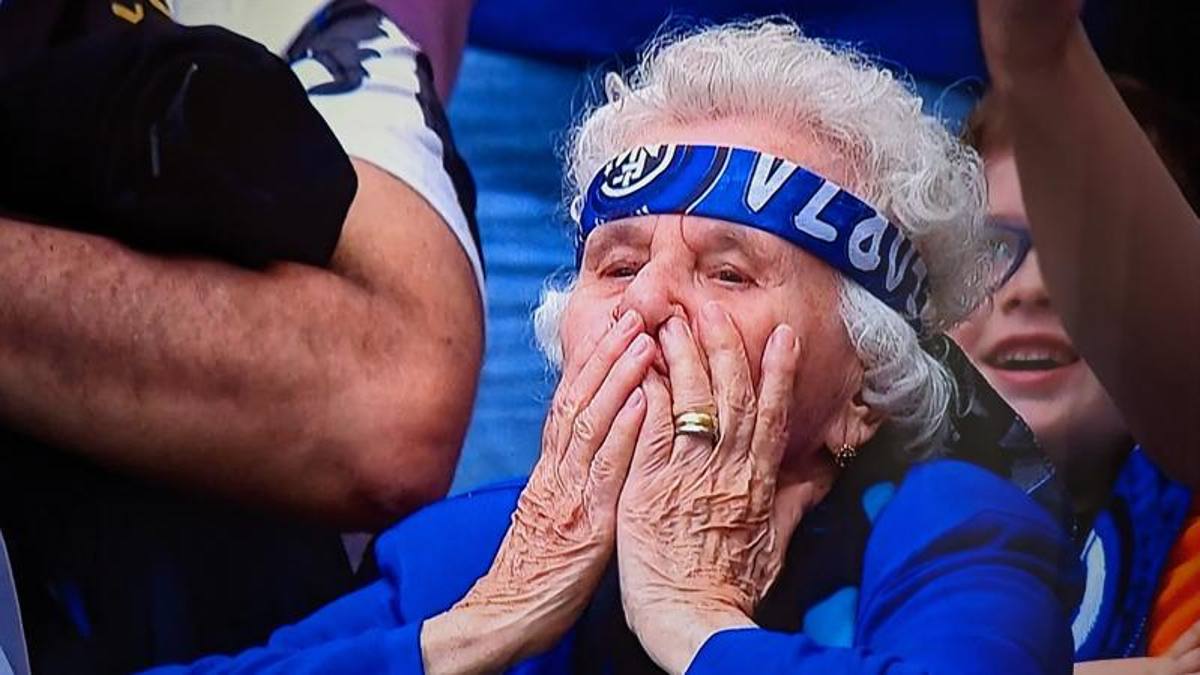
Tutti pazzi per Giuseppina, la nonna tifosa dell’Inter

Everybody loves Giuseppina, the Inter Milan grandma fan

alla fine della partita tra Inter e Lazio, vinta dall’Inter per 3-1, le telecamere hanno inquadrato Giuseppina, una tifosa dell’Inter che esultava in modo sfrenato, con baci e salti di gioia.

Una tifosa come Tanti, insomma. solo che Giuseppina ha 86 anni! 

“Ho 86 anni”, racconta Giuseppina, “ma tifo per l’Inter da 87 anni, cioè da quando ero nella pancia di mia mamma, anche lei interista”.

allo stadio era con il nipote Dennis, di 26 anni, anche lui tifosissimo dell’Inter. Dennis la porta allo stadio ogni volta che ci va: “Se non la porto con me, non mi parla per giorni”, confessa Dennis.

Giuseppina è nata a San severo, in Puglia, ma vive a Torino da 70 anni. È interista da sempre, e infatti ha passato la sua passione per l’Inter a tutta la famiglia.

Le immagini della nonnina tifosa sono diventate virali e sono state apprezzate da tutti gli appassionati di calcio.


Keywords

la partita: match, game – 比赛

lo stadio: stadium – 体育场

inquadrare: to frame, to capture – 拍摄

tifoso/a: fan, supporter – 球迷

interista: Inter Milan supporter – 国际米兰球迷

esultare: to celebrate, to rejoice – 欢呼

sfrenato/a: unrestrained, unbridled – 放肆的, 不受限制的

tifare: to cheer, to support – 为…加油

la passione: passion – 激情

la nonnina: grandma – 奶奶

appassionato/a: enthusiast, passionate – 爱好者

Grammar

Diminutivi
Diminutives

“Le immagini della nonnina tifosa”
(The images of the granny fan)


“Nonnina” is an Italian word that is a diminutive form of the word “nonna”, which means “grandmother”.

The suffix “-ina” is a diminutive, used to indicate something smaller, more endearing, or more familiar.

Note that the diminutive in Italian not only indicates a smaller size but can also convey a sense of endearment or affection. Therefore, “nonnina” would often be used as a more affectionate term for “nonna”.

In Italian, the diminutive is formed by adding a suffix to the root word. Here are the most common diminutive suffixes:

  • “-ino/a”: This is one of the most common diminutive suffixes in Italian. For example, “gatto” (cat) becomes “gattino” (kitten), “ragazzo” (boy) becomes “ragazzino” (little boy), “ragazza” (girl) becomes “ragazzina” (little girl), “paese” (town) becomes “paesino” (little town).


  • “-etto/a”: This is another common diminutive suffix. For example, “cena” (dinner) becomes “cenetta” (cute dinner), “birra” (beer) becomes “birretta” (beer in a more colloquial slang).


  • “-ello/a”: This suffix is less common but still used. For example, “paese” (town) becomes “paesello” (little town).

Translation

At the end of the match between Inter and Lazio, which Inter won 3-1, the cameras captured Giuseppina, an Inter fan, celebrating wildly with kisses and jumps of joy.

She is just like any other fan, except for the fact that Giuseppina is 86 years old!

“I’m 86 years old,” Giuseppina says, “but I have been cheering for Inter for 87 years, since I was in my mother’s womb, and she was an Inter fan too.”

She was at the stadium with her 26-year-old nephew Dennis, who is also a huge Inter supporter. Dennis takes her to the stadium every time he goes: “If I don’t bring her with me, she won’t talk to me for days,” Dennis confesses.

Giuseppina was born in San Severo, in Puglia, but has been living in Turin for 70 years. She has always been an Inter fan and has passed down her passion for the team to her entire family.

The images of the granny fan have gone viral and have been appreciated by all football enthusiasts.
