
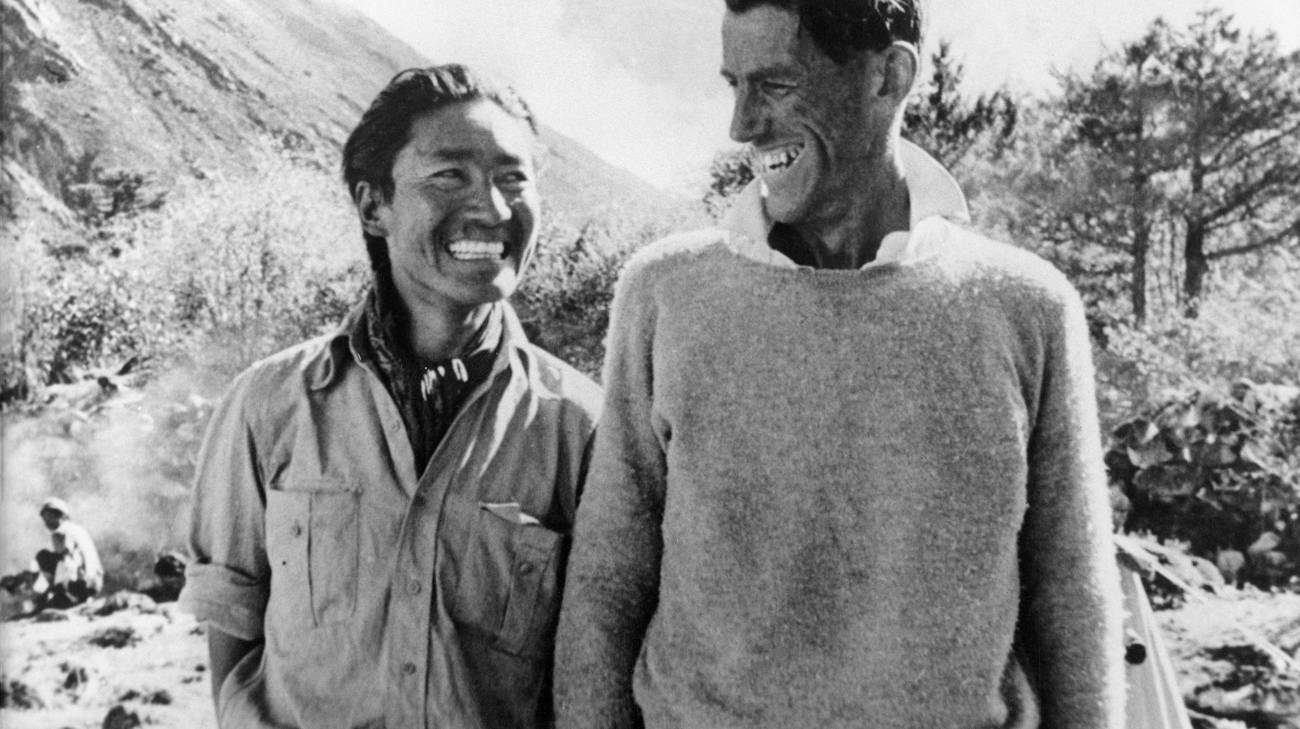
La conquista dell’Everest, 70 anni fa

The conquest of Everest, 70 years ago

“Perché è lì!”.

così rispondeva George Mallory, il leggendario alpinista inglese, a chi gli chiedeva perché fosse così determinato a voler scalare l’Everest. era il 1923, e l’anno dopo Mallory sarebbe morto proprio cercando di raggiungere la cima di quella montagna.

Il sogno di scalare la montagna più alta del mondo, però, non morì con Mallory. Tutt’altro.

Trent’anni dopo, il 29 maggio 1953, il neozelandese Edmund Hillary e il nepalese Tenzing Norgay entravano ufficialmente nei libri di storia: furono loro i primi uomini a raggiungere la vetta dell’Everest. 

I due arrivarono a 8.849 metri alle 11:30 del mattino. Scattarono alcune fotografie, Hillary seppellì una croce nella neve, mentre Norgay lasciò alcuni dolci in offerta a Qomolangma, la “divinità madre del mondo”, il nome tibetano dell’Everest. 

Rimasero una quindiCina di minuti sulla vetta, a tratti senza le maschere per l’ossigeno. poi iniziarono la discesa.
Keywords

l’ Everest: Mount Everest – 珠穆朗玛峰

alpinista: mountaineer – 登山者

scalare: to climb – 攀登

la cima: summit – 山顶

neozelandese: New Zealander – 新西兰人

nepalese: Nepali – 尼泊尔人

la vetta: peak – 高峰

tibetano/a: Tibetan – 藏族的

la divinità: deity – 神灵

Grammar

Condizionale passato: “il futuro nel passato”
Past conditional: the future in the past

“L’anno dopo, Mallory sarebbe morto proprio cercando di raggiungere la cima di quella montagna”
(The following year, Mallory would die while attempting to reach the summit of that mountain)

In Italian, the past conditional tense can be used to express future events from a past perspective. This is because it places the speaker in a past context, looking forward to a future event that had not yet happened.

In the above sentence, the use of “sarebbe morto” (he would die) places the speaker in a past context, anticipating a future event (the death of Mallory in 1924). It indicates that the speaker knew or expected Mallory’s death in the future, which eventually happened in 1924.

To illustrate the difference, if we were to use the normal future tense instead, the sentence would sound like this: “L’anno dopo, Mallory morirà proprio cercando di raggiungere la cima di quella montagna” (The following year, Mallory will die while attempting to reach the summit of that mountain). In this case, the sentence would imply a present or future perspective, without the connection to the past viewpoint.

Here are a few more examples:

  • Lui disse che avrebbe viaggiato per il mondo (He said he would travel the world.)
  • Pensavo che avresti capito (I thought you would understand.)

Translation

“Why is it there?” This was the response of George Mallory, the legendary English mountaineer, when asked why he was so determined to climb Everest. It was 1923, and the following year Mallory would tragically die while attempting to reach the summit of that mountain.

However, the dream of climbing the world’s highest mountain did not die with Mallory. Far from it.

Thirty years later, on May 29, 1953, New Zealander Edmund Hillary and Nepalese Tenzing Norgay officially entered the history books: they were the first men to reach the summit of Everest.

The two reached 8,849 meters at 11:30 in the morning. They took some photographs, Hillary buried a cross in the snow, while Norgay left some sweets as an offering to Qomolangma, the “mother goddess of the world,” the Tibetan name for Everest.

They stayed on the peak for about fifteen minutes, occasionally removing their oxygen masks. Then they began the descent.