Finché esisterà il Colosseo, esisterà anche Roma

As long as the Colosseum exists, Rome will also exist

se avete sentito parlare del Colosseo solo grazie al film “Il Gladiatore” con Ridley Scott, ecco un po’ di storia del simbolo di Roma.

Originariamente conosciuto come Amphitheatrum Flavium (in italiano “Anfiteatro Flavio”), il Colosseo è situato nel centro di Roma, ed è Il più grande anfiteatro del mondo. 

la sua costruzione fu iniziata dall’Imperatore Vespasiano nel 71/72 d.C. e fu inaugurato dal figlio Tito nell’80. 

L’edificio ha una forma ellittica di 527 metri di perimetro e un’altezza di 48,5 metri, che originariamente era di 52.

Era in grado di contenere fino a 87.000 spettatori, ed anticamente era usato per gli spettacoli di gladiatori e altre manifestazioni pubbliche. 

Nel 1980 è stato inserito nella lista dei Patrimoni dell’umanità dell’UNESCO, e nel 2007 è stato inserito anche fra le nuove sette meraviglie del mondo. 

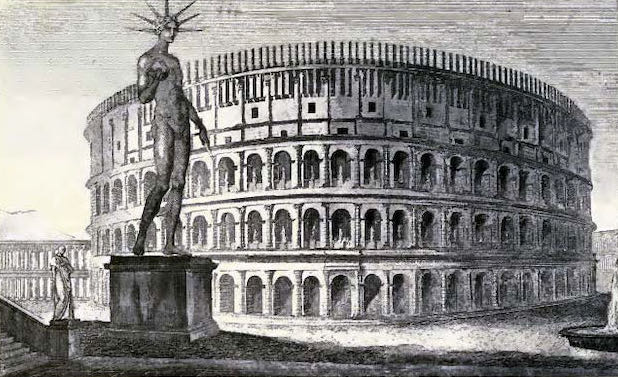
E il nome? Da dove viene? a quanto pare, il nome “Colosseo” si diffuse solamente nel Medioevo, e deriva probabilmente da una gigantesca statua di Nerone che si trovava nelle vicinanze, conosciuta con il nome di “Colosso di Nerone”. 

Tale statua, tuttavia, è sparita da migliaia di anni, mentre il Colosseo è ancora Qui con noi in tutto il suo splendore. 

E, stando ad una famosa profezia, ci sarà ancora per molto tempo:

«Finché esisterà il Colosseo, esisterà anche Roma;

quando cadrà il Colosseo, cadrà anche Roma;

quando cadrà Roma, cadrà anche il mondo»

Keywords

l’ anfiteatro: amphitheater – 圆形露天剧场

inaugurare: to inaugurate – 举行开幕典礼

ellittica/o: elliptical – 椭圆形的

il perimetro: perimeter – 周长

in grado di: capable of – 有能力

contenere: to contain – 包含

i gladiatori: gladiators – 角斗士

il Patrimonio dell’umanità: World Heritage – 世界遗产

le sette meraviglie del mondo: Seven Wonders of the World – 世界七大奇迹

derivare: to derive – 起源

la statua: statue – 雕像

la profezia: prophecy – 预言

cadere: to fall – 掉落

Grammar

Il passivo
Passive form

“La sua costruzione fu iniziata dall’Imperatore Vespasiano nel 71/72 d.C. e fu inaugurato dal figlio Tito nell’80”
(The construction was started by Emperor Vespasian in 71/72 AD and was inaugurated by his son Titus in 80)

The passive form in Italian is formed by using the auxiliary verb “essere” (to be) followed by the past participle of the main verb.
The subject of the sentence becomes the object of the verb, and the object (if there is one) becomes the subject.
The agent, or the person or thing performing the action, is often introduced by the preposition “da” (by).

For example:

  • La mela è stata mangiata da lui. (The apple was eaten by him.)

In this sentence, “è stata mangiata” is the passive form of “ha mangiato” (ate). “La mela” (the apple) is the subject/object, and “da lui” (by him) is the agent.
The active form would be “Lui ha mangiato la mela” (He ate the apple)

The passive form is often used when the focus is on the action rather than the person or thing performing the action.
It can also be used to avoid mentioning the person or thing performing the action, or when the identity of the performer is unknown or unimportant.

Translation

If you only know about the Colosseum thanks to the movie “Gladiator” by Ridley Scott, here is a bit of history about Rome’s symbol.

Originally known as the Amphitheatrum Flavium (in Italian “Anfiteatro Flavio”), the Colosseum is located in the center of Rome and is the largest amphitheater in the world.

Its construction was started by Emperor Vespasian in 71/72 AD and was inaugurated by his son Titus in 80 AD. The building has an elliptical shape with a perimeter of 527 meters and a height of 48.5 meters, which was originally 52 meters.

It was able to accommodate up to 87,000 spectators and was used in ancient times for gladiatorial games and other public events.

In 1980, it was included in the UNESCO World Heritage List, and in 2007, it was also included among the New Seven Wonders of the World.

And the name? Where does it come from? Apparently, the name “Colosseum” only spread in the Middle Ages and probably derives from a gigantic statue of Nero that was nearby, known as the “Colossus of Nero.”

However, this statue has been missing for thousands of years, while the Colosseum is still here with us in all its splendor. And according to a famous prophecy, it will be here for a long time:

“As long as the Colosseum stands, Rome will stand;
when the Colosseum falls, Rome will fall;
when Rome falls, the world will fall.”