
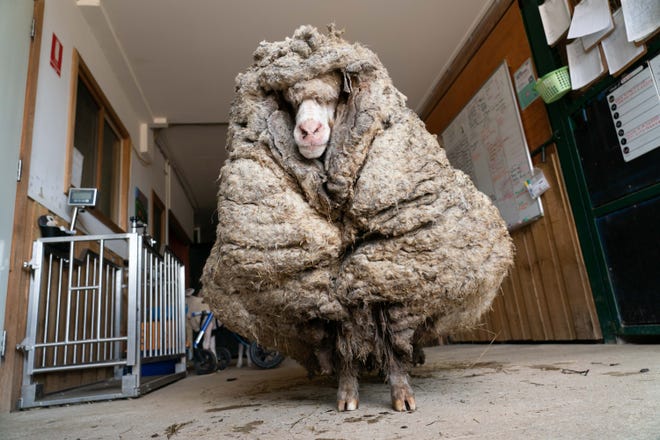
Baarack, la pecora con 35kg di lana

Baarack, the sheep with 35kg of wool

Una pecora selvatica è stata scoperta in un bosco australiano con oltre 35 kg di lana addosso. 

Una quantità veramente eccessiva che stava portando l’animale a morte certa: Baraack, così è stata chiamata, era infatti malata e non riusciva nemmeno a vedere per via della troppa lana. 

fortunatamente, dopo l’avvistamento di un semplice cittadino, Baraack è stata soccorsa da una organizzazione locale che si occupa di protezione degli animali, l’Edgar’s Mission Farm Sanctuary. 

“Con molta probabilità, in passato Baarack aveva un proprietario“, ha spiegato uno dei soccorritori del Santuario. 

tuttavia, a giudicare dalla quantità di lana, probabilmente viveva allo stato brado da almeno 5 anni: le pecore odierne, infatti, hanno bisogno di almeno una tosatura annuale, conseguenza del secolare allevamento selettivo umano per massimizzare la produzione di lana.

Keywords

la pecora: sheep – 绵羊

selvatico/a: wild – 野生的

la lana: wool – 羊毛

addosso: on – 在身上

soccorrere: to rescue – 援救

la protezione degli animali: animal protection – 动物保护

a giudicare da: judging from – 从…判断

allo stato brado: free-range – 散养的

avere bisogno (di): to need – 需要

annuale: annual, 一年一次

l’ allevamento: breeding – 养殖

Grammar

Stare + gerundio = forma progressiva
Progressive form

“Una quantità veramente eccessiva che stava portando l’animale a morte certa”
(The excessive amount of wool was putting the sheep’s life at risk)

In the sentence above, the verb “stava portando” is in the progressive form, which is formed with the auxiliary verb “stare” followed by the gerund (-ando, -endo) of the main verb.

In Italian, the progressive form is used to describe an ongoing action that is taking place at a specific moment in time. 

For example:

  • Stavo mangiando la pizza quando è suonato il telefono. (I was eating pizza when the phone rang.)
  • La mia amica stava guardando la televisione quando è arrivata la posta. (My friend was watching TV when the mail arrived.)


In both of these examples, the action described was ongoing when something else happened, and the progressive form is used to indicate that ongoing action.

Translation

A wild sheep was discovered in an Australian forest with over 35 kg of wool on its body.

The excessive amount of wool was putting the sheep’s life at risk: the sheep, named Baarack, was sick and couldn’t even see due to the too much wool.

Fortunately, after being spotted by a simple citizen, Baarack was rescued by a local animal protection organization, the Edgar’s Mission Farm Sanctuary.

“Most likely, Baarack had an owner in the past,” explained one of the sanctuary rescuers.

However, judging by the amount of wool, Baarack probably lived in the wild for at least 5 years: modern sheep, in fact, need at least one shearing per year, a consequence of the centuries-long human selective breeding to maximize wool production.
