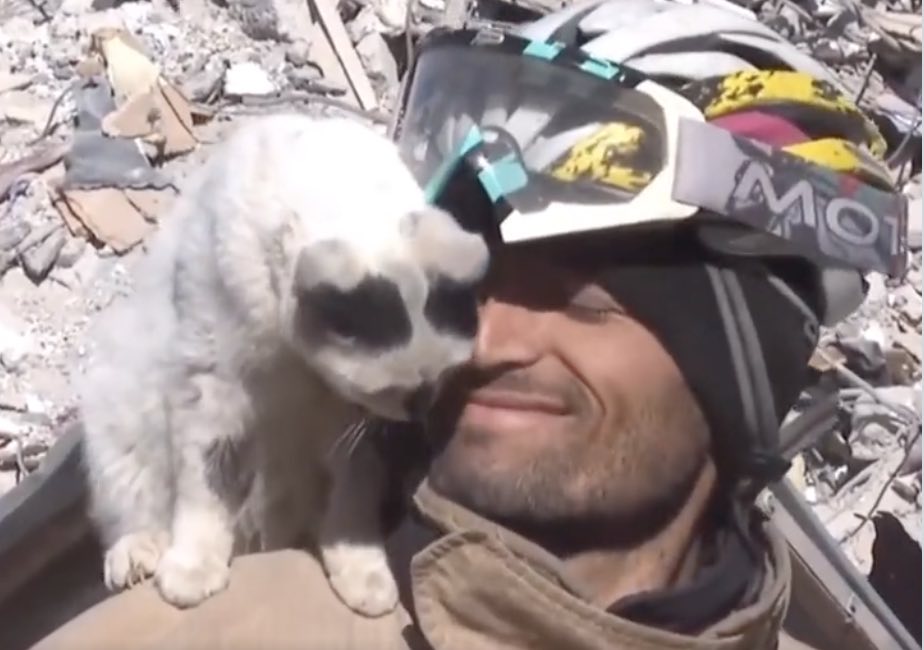
Enkaz, il gatto salvato dal terremoto in Turchia

Enkaz, the cat saved from the earthquake in Turkey

Dalla Turchia, purtroppo, arrivano continuamente notizie drammatiche per il terribile terremoto. questa, per fortuna, è una bella storia.

qualche giorno fa, un ragazzo turco di nome ali Cakas ha salvato un gatto ancora vivo tra le macerie delle case, ben 130 ore dopo il terremoto. 

Ali è un ciclista, ma in questo momento fa il volontario per aiutare le vittime del terremoto che ha colpito la Turchia e la Siria il 6 febbraio.

Il gatto bianco e nero era ferito e stanco, ma adesso sta già meglio. Dal momento in cui è stato salvato, il gatto non ha mai più lasciato il suo salvatore.
Ali lo ha curato e lo ha adottato, e lo ha chiamato “Enkaz”, cioè “macerie” in turco.

La foto dei due insieme è diventata virale sui social, e ora molte persone da tutto il mondo seguono la loro storia. Una piccola storia di speranza e di solidarietà in un momento di tragedia.

Keywords

drammatico/a: dramatic – 戏剧性的

il terremoto: earthquake – 地震

turco/a: Turkish – 土耳其的

il gatto: cat – 猫

vivo/a: alive – 活着的

le macerie: rubble, debris – 瓦砾,残骸

il volontario: volunteer – 志愿者

le vittime: victims – 受害者

ferito/a: injured – 受伤的

dal momento in cui: since, from the moment when – 自从

il salvatore: savior, rescuer – 救援者

adottare: to adopt – 领养

la speranza: hope – 希望

positivo/a: positive – 积极的

Grammar

Pronome diretto LO
Direct object pronoun LO

“Ali lo ha curato e lo ha adottato, e lo ha chiamato Enkaz”
(Ali took care of him, adopted him, and named him “Enkaz”)

In this sentence, “lo” is a pronoun that can be translated as “him” in English. The first “lo” refers to the cat that Ali saved and is taking care of, and is therefore the direct object of the verb “ha curato” (cured/taken care of). The second “lo” refers back to the same cat, which Ali has adopted, and is again the direct object of the verb “ha adottato” (adopted). The third “lo” also refers to the same cat and is the direct object of the verb “ha chiamato” (called).

  • Ali ha curato il gatto (Ali took care of the cat) > Ali lo ha curato (Ali took care of him)
  • Ali ha adottato il gatto (Ali adopted the cat) > Ali lo ha adottato (Ali adopted him)
  • Ali ha chiamato il gatto (Ali named the cat) > Ali lo ha chiamato (Ali named him)

In Italian, pronouns are used to replace nouns that have already been mentioned or are clear from the context, in order to avoid repeating the same noun multiple times in a sentence. In this case, the repeated use of “lo” refers to the same cat throughout the sentence, and avoids the need to repeat its name or use a longer description each time.

Translation

From Turkey, unfortunately, continuous dramatic news comes due to the terrible earthquake. However, this is a beautiful story. 

A few days ago, a Turkish boy named Ali Cakas saved a still alive cat from the rubble of a building, 130 hours after the earthquake. 

Ali is a cyclist but is currently volunteering to help the victims of the earthquake that hit Turkey and Syria on February 6th. 

The black and white cat was injured and tired but is already doing better. Since being rescued, the cat has never left his savior.
Ali took care of him, adopted him, and named him “Enkaz,” which means “rubble” in Turkish. 

The photo of the two together went viral on social media, and now many people from all over the world follow their story. A little story of hope and solidarity in a time of tragedy.