
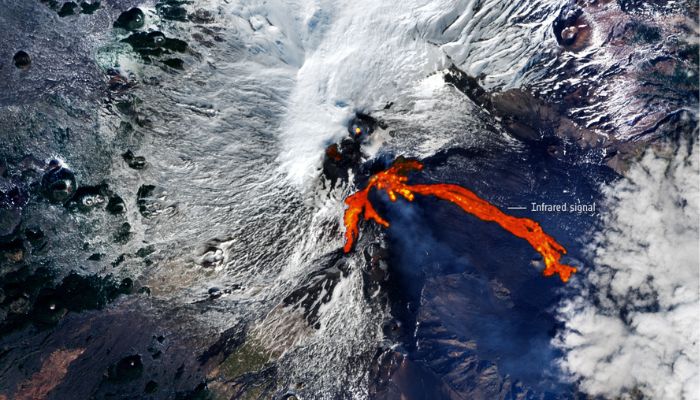
L’eruzione delľ Etna vista dallo Spazio

Eruption of Etna seen from Space

L’Agenzia Spaziale europea (ESA) ha pubblicato una foto del vulcano Etna scattata dallo Spazio. La foto satellitare mostra la seconda eruzione degli ultimi giorni, quella del 18 febbraio. 

La prima eruzione del 16 febbraio aveva provocato una colata lavica sul lato orientale dell’Etna molto spettacolare, senza per fortuna mettere a rischio le case limitrofe. 

anche il 19 febbraio l’Etna ha continuato ad eruttare con altre colate laviche sui suoi versanti orientale e meridionale. 

L’Etna, che con i suoi 3.300 metri svetta sulla costa orientale della Sicilia, è il vulcano più alto d’Europa e uno dei più attivi del mondo.

Keywords

l’ Agenzia Spaziale Europea: European Space Agency – 欧洲空间局

il vulcano: volcano – 火山

l’ Etna: Etna – 埃特纳

l’ eruzione: eruption – 爆发

la colata lavica: lava flow – 熔岩流

mettere a rischio: put at risk – 使处于危险之中

il versante: slope – 山坡

attivo/a: active – 活跃的

Grammar

Trapassato prossimo
Past perfect

“La prima eruzione del 16 febbraio aveva provocato una colata lavica”
(The first eruption on February 16th had caused a lava flow)

The trapassato prossimo (past perfect) tense is used to describe an action that took place before another action in the past. In the sentence, “aveva provocato” (had caused) is in the trapassato prossimo because it is referring to the first eruption that occurred on February 16th, which is in the past relative to the second eruption that is being discussed in the previous sentence. 

The passato prossimo (present perfect) would have been used if the sentence had described only the first eruption without referring to the second eruption.

Here are a few examples to illustrate the difference between the two tenses:

  • Trapassato prossimo: “Avevo già mangiato quando sei arrivato” (I had already eaten when you arrived.)
  • Passato prossimo: “Ho mangiato una pizza ieri sera” (I ate a pizza last night.)


In the first example, “avevo mangiato” (had eaten) is in the trapassato prossimo because it happened before “sei arrivato” (you arrived) in the past. 

In the second example, “ho mangiato” (ate) is in the passato prossimo because it is a completed action in the past without any relation to another past action.

Translation

The European Space Agency (ESA) has published a photo of Mount Etna taken from space. The satellite image shows the second eruption in the past few days, that of February 18th.

The first eruption on February 16th had caused a very spectacular lava flow on the eastern side of Mount Etna, without fortunately putting neighboring houses at risk.

On February 19th, Mount Etna continued to erupt with more lava flows on its eastern and southern slopes.

Mount Etna, which stands at 3,300 meters on the eastern coast of Sicily, is the highest volcano in Europe and one of the most active in the world.
